


Trusting God to Multiply
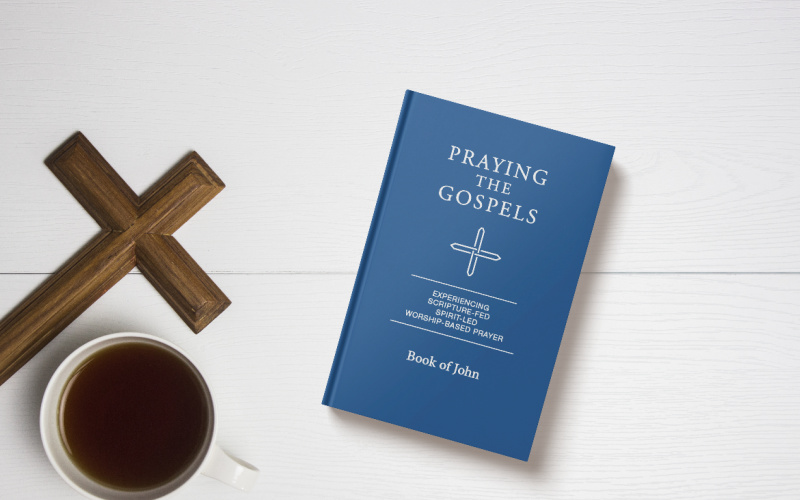
(This devotional is excerpted from Praying the Gospels: Book of John, our brand-new resource in Scripture-fed, Spirit-led, worship-based prayer. Like its predecessor, Praying the Psalms, this book will introduce you to—or strengthen—an approach to prayer that is biblical and life-giving. Each section of the book will include a helpful summary along with a biblical guide for prayer. Praying the Gospels: Book of John will release late spring 2026.)
John 6:1-21
With each miracle Jesus’ popularity was increasing, and John tells us here in verse 2 that a large crowd kept following Jesus, this time all the way to the other side of the Sea of Galilee where He was resting with His disciples. Jesus’ ministry is marked by His love for people and willingness to make time for those who are seeking Him. We also see here that Jesus planned to perform the miracle of feeding the large crowd with the help of His disciples. He did not need their help, but invited them to participate in the miracle He was about to perform. Eventually, He would commission the disciples to carry forward His ministry after His death, resurrection and ascension to Heaven. How often does Jesus’ call to serve Him seem impossible?
Pause and picture the scene: the shore full of faces, the murmur of expectation, the disciples exhausted yet attentive. This image is more than a historical moment; it is a living lesson for every believer who has ever felt small, inadequate, or overwhelmed. When crowds gather around a need, when problems feel greater than the hands available to help, God is preparing a stage for His greatness to be revealed through ordinary people. The fact that Jesus rested with His disciples before acting shows that preparation and peace precede provision. We are invited first to be with Him, to draw strength from His presence, and then to act in obedience, however little we possess.
When crowds gather around a need, when problems feel greater than the hands available to help, God is preparing a stage for His greatness to be revealed through ordinary people.
John recounts that there were 5,000 men in the crowd. It’s quite likely, then, that the crowd was actually 15,000 or more, counting the women and children. Seeing the crowd coming, He asked Philip, “Where are we to buy bread, so that these people may eat?” (v. 5). As Philip assessed the situation, he easily determined the cost was too expensive and unrealistic. Andrew took a quick inventory of those in the crowd around him, only to find one boy with enough food for his family. Clearly, what Jesus was asking of His disciples was impossible. But, as John indicates in verse 6, that is exactly why Jesus asked His disciples to join Him.
Let this sink in: Jesus asked the disciples because the task was beyond them. He did not ask them because He lacked resources; He asked them because He wanted to teach them to rely on Him as they participate in His work. The call into the impossible is the classroom where faith grows. When we are faced with tasks that exceed our experience, talent, or resources, we learn to pray bolder prayers, to depend more fully on Christ, and to discover that our small offerings become channels for God’s multiplication. The boy who shared his lunch did not know he was entering a story that would be told for millennia; his faithfulness modeled for us that no gift is too small to change the world when placed in Jesus’ hands.
When we are faced with tasks that exceed our experience, talent, or resources, we learn to pray bolder prayers, to depend more fully on Christ, and to discover that our small offerings become channels for God’s multiplication.
Indeed, the task was impossible! That is, apart from the authority and power of Jesus to multiply the little that the disciples had into an abundance far beyond what was actually needed. By the end of this miracle, not only was the entire crowd full and satisfied, but the disciples collected twelve baskets full of leftover bread. Five loaves of bread fed five thousand men, plus women and children, and the disciples came back to Jesus with more bread than they originally started with.
Think about the symbolism of the twelve baskets. The leftovers remind us that God’s provision is not merely sufficient; it is abundant. We are often focused on scarcity – what we lack, what we cannot do, who we are not. The miracle reframes the narrative: God specializes in turning scarcity into surplus. This should embolden us to act, to serve, and to give without hoarding, trusting that God’s multiplication includes provision for ongoing work and unexpected needs.
Trust God to Multiply What We Have
Like the disciples, Jesus wants to meet the needs of people – physically and spiritually – through us. Sometimes Jesus’ call to serve is well within our resources and abilities. Other times, His call is entirely impossible in our own efforts. When Jesus’ plan is greater than our ability, we need to remember that Jesus is not concerned about what we do not have. Rather, He expects us to give Him what we do have – our fishes and loaves – and trust Him to multiply them for His purposes and glory. Whenever Jesus is calling us to join Him in the impossible, we can expect a miracle, because Jesus will always provide whatever is needed to do His will.
Allow this to become a guiding posture: give what you do have, however small, and trust God to do more than you can imagine with it. Practical faith looks like offering your time, your skills, your money, your influence, and even your doubts to Jesus. It looks like stepping into service when the odds are against you and choosing obedience over analysis. The disciples’ obedience enabled them to not only witness a miracle, but to participate in it. Miracles do not always occur on our timetable, but they reliably follow surrendered obedience.
Miracles do not always occur on our timetable, but they reliably follow surrendered obedience.
Finally, remember that participating in God’s work changes us as much as it changes others. Each disciple returned with a basket full of bread. They also returned with transformed hearts – hearts that had seen God provide, hearts that had witnessed the joy and satisfaction of a multitude fed, hearts prepared for the greater commission ahead. When we step into God’s impossible assignments, we are not merely solving problems; we are being shaped into the kind of people who can steward greater things. Let the story of the feeding of the 5,000 be your encouragement: bring your little, trust the Lord, serve sacrificially, and watch how God multiplies faith into fruit that feeds nations and forms disciples.
When we step into God’s impossible assignments, we are not merely solving problems; we are being shaped into the kind of people who can steward greater things.
PRAYER GUIDE
Reverence – Identify and celebrate God’s praiseworthy attributes.
- Jesus sees us. – v. 5
- He cares about our needs. – v. 5
- Jesus is sovereign. – v. 6
- He is our provider, and He is able to provide abundantly. – vv. 11-13
Prayer Prompts
- Jesus, thank You for seeing me when I came to You needing … (v. 5)
- Jesus, thank You for giving me an abundance of Your … (vv. 11, 13)
- Jesus, thank You for allowing me to join You in the miracle of … (vv. 5-6)
Response – Surrender to Him and His ways.
- Lord, I confess that I get trapped in a scarcity mindset when … (vv. 7-8)
- Lord, I trust that You see my need for more … (v. 5)
- Lord Jesus, I trust You to provide so that I can glorify You. (vv. 11-14)
Requests – Ask the Spirit to guide prayer over concerns, resources, and relationships.
- Lord, help me remember that not even … is impossible for You. (vv. 7-11)
- Jesus, multiply what I have and use me to meet the needs of … (vv. 11-12)
- Lord, help (person or group) have a mindset of abundance as we follow You. (vv. 13)
Readiness – Encouragement and strength for spiritual battle.
- Lord, protect me from Satan’s lies that You are not able to … (vv. 7-8)
- Remind me that my little offering of … is more than enough in Your hands. (v. 8)
- When I’m feeling inadequate, I will trust Your power to … (vv. 10-11)
Memorize and meditate on verse 11.
Copyright © 2026 Jeremiah Porter. All rights reserved.
 Skip to content