

Walk Through It
The Grand Canyon in Arizona is the most famous valley in the United States. It is over a mile deep, 277 miles long, and up to 18 miles wide. Death Valley is arguably the second most famous valley, with the lowest elevation in the United States at 282 feet below sea level. For those familiar with Bible history, they might point to the Mesopotamian Valley, historically known as the Fertile Crescent and the Cradle of Civilization, which is located between the Tigris and Euphrates rivers. A valley is a low spot, often with mountains or hills on each side.
I draw our attention to a valley mentioned in Psalm 23:4, traditionally translated as “The Valley of the Shadow of Death.” Some newer translations, such as the NLT or CSB, refer to it as “The Darkest Valley.” We know more about this than any other valley in the world because we will journey through this valley often in our lives. It is more than a geographical location; it is a place of our soul that has had struggles, disappointments, and pain pressed upon it. In Job 14:1, Job says, “Man is but a few days and full of trouble.”
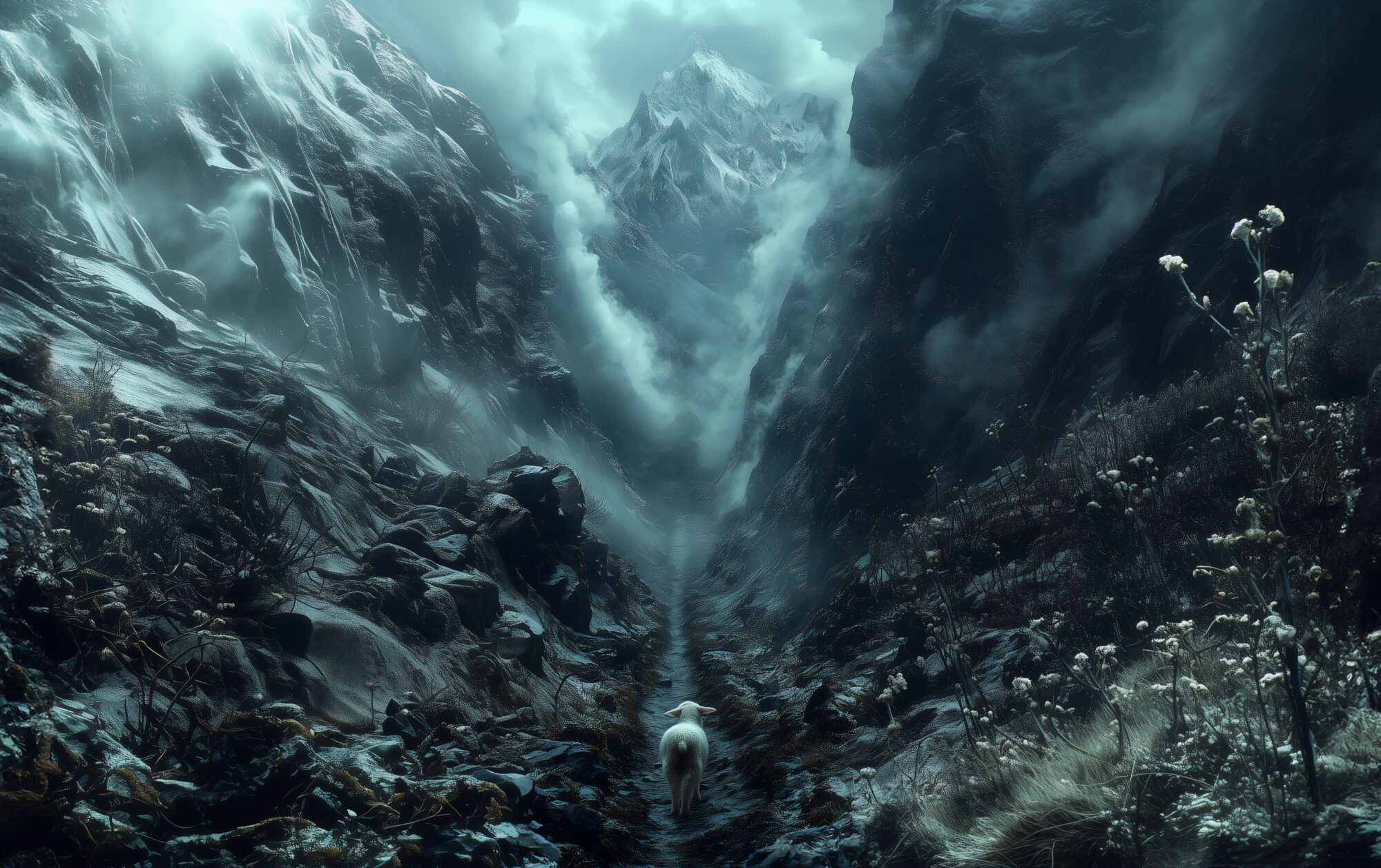
David, a shepherd in his young days, knew the duties of a shepherd. He knew what it was to lead his sheep into dangerous places. The valleys were dark, carved out in the narrow crevices of the Judean hills. At times, there would be pools of water at the bottom and cool spots in the shade from the hot sun. However, to descend from the hillsides, it would take the careful skill of a shepherd to stay ahead of the sheep, protect them, and call out with his familiar voice.
There are certain truths in this one verse that help us navigate the journey.
First, there is the reality that valleys will inevitably occur. Life is not all flat land. Psalm 23 is often found on grave markers and programs for funerals and other places that commemorate death. But this is not about death; it is about life. It is the undeniable truth that we will have valleys, and sometimes those valleys will be deep and long. David did not say, “If I walk through the valley.” He said, “Even though.” He knew that with sheep and in his own life, there would be valleys. Even with the best-ordered life, valleys will come. They are necessary for the good of the sheep, and God recognizes them as necessary for His children. The valley will be essential for our growth. We read in 1 Peter 4:12, “Beloved, do not be surprised at the fiery trial when it comes upon you to test you, as though something strange were happening to you.”
Even with the best-ordered life, valleys will come. They are necessary for the good of the sheep, and God recognizes them as necessary for His children. The valley will be essential for our growth.
Second, there will be dark valleys. Some of the valleys will be so dark that they will feel like death has surrounded you. You will wonder whether the pressure will end, the suffering will cease, the funds will ever come, the prodigal will come home. You will want to run, but David said, “I walk.” If you run, you can stumble; you can miss seeing what God, your shepherd, wants you to see and learn. Those in the Bible were not strangers to dark valleys. David walked in the valley of Elah, where he faced possible death from Goliath. The Valley of Baca was the Valley of Weeping (Psalm 84:6). Hosea walked through the Valley of Achor, meaning the Valley of Trouble. In Israel, there was and remains the Valley of Kidron, known as the Valley of Death. On the east side of Jerusalem, there is a steep hill that leads to a valley where people were and are buried today. It exists between the city and the Garden of Gethsemane. In ancient times, they would light torches in Jerusalem, illuminating the city at night. However, the hillside would cast a shadow over the Valley of Kidron, causing darkness.
Third, remember that your shepherd is with you. David shifts from discussing God in the first three verses, where he refers to Him in the third person, to addressing Him directly in verse four. He now declares, “You are with me.” In the darkness, as you carefully take each step, the Savior is there. Your God is walking ahead of you. You might not see Him, you might not even feel Him, but He is there. His voice is still ahead. His rod is there to protect you, and His staff is pulling you towards Him. He will walk through it with you. You will need to listen to Him when you can’t see Him. He has not left you. He plans to take you through the valley, not leave you in it. However, as your Lord, He will determine where and when you will exit.
In the darkness, as you carefully take each step, the Savior is there. Your God is walking ahead of you. You might not see Him, you might not even feel Him, but He is there.
Fourth, there is no need to fear. Again, David speaks directly with his shepherd. He says, “I will not fear, for you are with me and your rod and your staff comfort me.” This darkest of valleys has danger, but David chooses not to fear. He declares, “I will not fear.” Fear is a choice. David’s choice was based on verse one. The “Lord” Yahweh is my shepherd. He had made the decision that the Lord was his shepherd. The choice was based upon Yahweh; David understood the character, power, and strength of the Lord. He is God; thus, David did not need to fear. My Lord has more than a rod and staff; He has the strength, wisdom, and power to create this world. This dark valley is nothing to Him. So, David chose not to fear. When the darkest of valleys come, make a choice not to fear. It has been said that there are 365 “fear nots” in the Bible. There are enough “fear nots” for us to grasp when our dark valley comes. Grab onto them.
When the darkest of valleys come, make a choice not to fear. It has been said that there are 365 “fear nots” in the Bible. There are enough “fear nots” for us to grasp when our dark valley comes. Grab onto them.
Finally, there is a purpose for dark valleys. In the valleys, God allows His work to make you better, not bitter. God’s purpose is stated throughout Scripture. James says when trials come in a variety of ways, it is for the testing of our faith, producing steadfastness, which, when the whole process is completed, makes us perfect and complete. Peter tells us, “And after you have suffered a little while, the God of all grace, who has called you to his eternal glory in Christ, will himself restore you and make you strong, firm, and steadfast” (1 Peter 5:10). Your shepherd allows dark valleys to restore you to be better, never desiring you to be bitter. Remember, your shepherd takes you all the way through; He doesn’t leave you halfway. Also, remember that it is a shadow, and a shadow cannot harm you. To have a shadow, there must be light. Jesus, your Savior, is the light. Yes, it could be that the light is the door open to heaven, opening a path to a better and higher place. Thus, the valley should never be feared, because what others might seem to interpret as the worst for you is the best for you; so never fear or worry in the valley, because you will come out better one way or another.
Peter tells us, “And after you have suffered a little while, the God of all grace, who has called you to his eternal glory in Christ, will himself restore you and make you strong, firm, and steadfast” (1 Peter 5:10). Your shepherd allows dark valleys to restore you to be better, never desiring you to be bitter.
Copyright © 2025 Dennis Henderson. All rights reserved.
 Skip to content